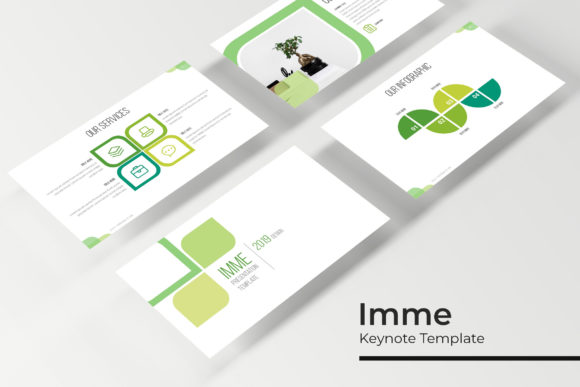
Imme Keynote Template: Streamlining Professional Presentation Workflows
In the landscape of professional communication, the friction between having a solid idea and visualizing it effectively often dictates the success of a project. The Imme Keynote Template serves as a structural bridge in this process, functioning not merely as a collection of slides but as a comprehensive design system for presenters. For entrepreneurs, educators, marketers, and freelancers, this template integrates directly into the planning and execution phases of business workflows, reducing the cognitive load associated with layout design while maintaining high standards of visual consistency.
Understanding where Imme fits requires looking at presentation creation as a production pipeline rather than a singular creative act. Before a single word is written, professionals must establish a visual framework that supports their narrative. With 150 total slides distributed across five distinct premade color variations, Imme provides immediate modularity. This volume allows users to approach deck building with an assembly mindset. Instead of designing from scratch, you are curating pre-validated layouts. This shifts the workflow from "creation" to "configuration," significantly accelerating the timeline from concept to final delivery without sacrificing pixel-perfect quality.
Strategic Color Management and Brand Consistency
Color is rarely just an aesthetic choice in professional settings; it is a functional tool for categorization, emphasis, and brand alignment. The Imme template addresses this through its architecture of five separate PPTX files, each representing a unique color variation with 30 dedicated slides. This separation is a deliberate organizational feature that impacts how teams manage assets.
Rather than forcing users to manually recolor individual elements across hundreds of slides—a process prone to error and inconsistency—Imme isolates these themes. In a practical workflow, this means a marketing team can maintain a master corporate deck in one file while using a secondary color variation for internal training or specific client pitches. When integrating with broader brand guidelines, users can select the base file that most closely matches their identity, minimizing the adjustment period. This structure also aids in version control. By keeping color schemes in separate source files, you prevent accidental overwrites and ensure that legacy presentations remain intact even as current branding evolves.
Data Visualization Through Handcrafted Infographics
The translation of complex data into digestible visuals is often the bottleneck in report generation and educational content. Generic charting tools frequently lack the nuance required for high-stakes storytelling. Imme incorporates handcrafted infographic slides that function as editable vector graphics within PowerPoint and Keynote environments. These are not static images; they are fully resizable and editable components built on master slides.
For analysts and educators, this distinction is critical. During the drafting phase, you might realize that a three-step process diagram needs to become a five-step cycle. Because these infographics are native to the presentation software, adjustments happen in real-time without returning to external design software like Illustrator or Canva. This interoperability keeps the user within their primary workspace, preserving momentum. Furthermore, the handcrafted nature of these illustrations ensures that even when resized for different aspect ratios or print formats, the line weights and proportions remain balanced. This level of quality control is essential for publishers and consultants whose reputation relies on polished, professional deliverables.
Master Slides and Efficient Asset Placement
Efficiency in presentation design is defined by how quickly global changes can be applied locally. The Imme template leverages Master Slides to enforce consistency across all 150 slides. For users managing large decks or recurring series, this is the engine of scalability. Picture placeholders utilize a drag-and-drop mechanic that respects the underlying grid system, ensuring that photographs never distort the layout or break alignment.
This technical foundation supports a non-linear editing process. You can populate content rapidly using placeholders, then refine specific slides later without worrying about breaking the overall design language. For freelancers handling multiple clients, this system allows for rapid prototyping. You can drop in client assets to visualize the final output during early approval stages, confident that the spacing and typography will hold up in the final version. It is important to note, however, that while the layout infrastructure is robust, the photographs seen in previews are for illustration purposes only. Users must supply their own imagery, which reinforces the template’s role as a container for original content rather than a stock photo repository.
Navigation and Structural Organization
A common failure point in lengthy presentations is poor navigation, leading to audience disengagement. Imme includes dedicated Section Break slides and Gallery/Portfolio layouts specifically designed to manage information flow. These are not decorative pauses; they are functional signposts that aid both the presenter and the viewer.
In an educational or training context, section breaks serve as cognitive resets, signaling transitions between modules. For creative professionals using the portfolio layouts, these slides provide a standardized grid for showcasing work samples. The utility here extends beyond the live presentation. When exporting decks to PDF for email distribution or archival, these structural elements create a navigable document. Clients and stakeholders can scan through section headers to find relevant information without watching a linear video recording. This dual-purpose functionality makes the template valuable for both synchronous meetings and asynchronous communication workflows.
Technical Integration and File Management
Adopting a new template system requires understanding its technical footprint. Imme delivers five PPTX widescreen files accompanied by a Readme document and links to free fonts. This package structure acknowledges the reality of cross-platform collaboration. While marketed as a Keynote-compatible resource, the provision of PPTX files ensures accessibility for teams entrenched in the Microsoft ecosystem.
The inclusion of free font download links eliminates licensing ambiguity, a frequent legal and logistical hurdle in commercial projects. Before beginning any project with Imme, the first step should always be installing these typefaces to prevent substitution errors that alter spacing and hierarchy. The Readme file acts as the technical manual, offering guidance on customization limits and best practices. Treating this documentation as part of the onboarding process prevents frustration later. Additionally, because the files are widescreen (16:9), they align with modern display standards, though users intending to print handouts should verify margin safety zones within the master slide settings to accommodate varying paper sizes.
Long-Term Utility and Workflow Adaptation
The true value of a premium template like Imme emerges over repeated use. Initially, it serves as a time-saver for a specific deadline. Over time, it becomes a personalized design system. Productivity-minded users often duplicate the cleanest master file to create their own proprietary templates, stripping out unused slides and adding custom logos or footer information. This evolution transforms a purchased asset into a sustainable business tool.
For small business owners and solopreneurs, this reduces decision fatigue. Instead of debating font pairings or color contrast for every quarterly review, those decisions are baked into the system. The mental energy saved can be redirected toward refining the message itself. However, users must remain disciplined. The abundance of 150 slides can tempt presenters to include more content than necessary. Effective implementation involves selecting only the slides that serve the narrative arc, treating the remaining options as a reserve library rather than a checklist. By viewing Imme as a flexible component system rather than a rigid sequence, professionals can integrate it seamlessly into diverse workflows, from investor pitches to classroom lectures, ensuring consistent quality and efficient execution across every engagement.