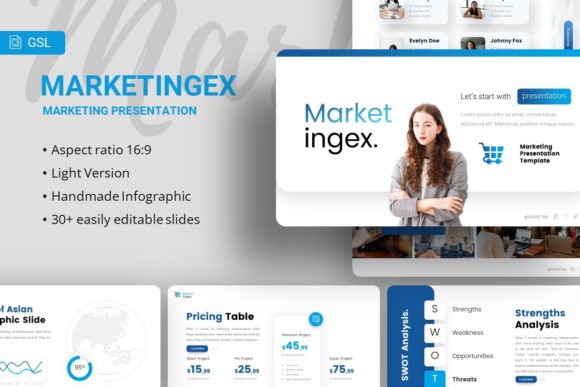
Google Slides - Marketingex Template Guide
Elevating a brand’s visual narrative requires more than just compelling copy; it demands a cohesive design system that translates complex ideas into digestible, engaging visuals. For designers and marketers seeking to streamline this process without sacrificing aesthetic quality, Google Slides - Marketingex offers a sophisticated foundation for modern visual communication. This resource bridges the gap between rigid corporate reporting and dynamic creative storytelling, allowing professionals to maintain high standards of graphic design while working within accessible cloud-based platforms.
Introducing Marketingex Marketing Google Slides Template
The Introducing Marketingex Marketing Google Slides Template is engineered specifically for versatility across multiple disciplines. Rather than serving as a generic layout, it functions as a comprehensive design kit suitable for Creative Agencies, Company Profiles, Corporate Business updates, Portfolios, Photography showcases, Pitch Decks, Startups, and Personal Portfolios. From a professional design perspective, the value lies in its structural integrity. The template includes 35 unique slides per variation, providing ample room to explore different content types without breaking visual consistency.
Crucially, this asset is built on Master Slides. For those familiar with editorial design or UI systems, this feature is non-negotiable. It ensures that global changes to typography, color palettes, or logo placement propagate instantly across the entire deck. This maintains strict brand identity adherence and significantly reduces production time, allowing designers to focus on content strategy rather than manual formatting adjustments.
Key Design Features and Assets
Effective visual hierarchy relies on custom graphics rather than stock clichés. Marketingex addresses this with handcrafted infographics and pixel-perfect illustrations that are fully resizable and editable. These vector-based elements ensure crisp rendering on any display, from mobile screens to large-format projection. The inclusion of drag-and-drop picture placeholders further enhances the workflow, making it easier to swap imagery while maintaining aspect ratios and composition balance.
- 35 Unique Slides: Comprehensive coverage for diverse narrative arcs.
- Master Slide Architecture: Ensures global consistency and rapid editing.
- Vector Infographics: Scalable data visualization tools included.
- Editable Illustrations: Custom art assets that adapt to brand colors.
- Documentation & Icons: Vector icon sets and guides included for ease of use.
Practical Applications in Visual Communication
While primarily a presentation tool, the design principles embedded in Marketingex extend to broader creative projects. The layouts serve as excellent starting points for social media graphics, where slide dimensions can be adapted for carousel posts or stories. Similarly, the structured grid systems used in the portfolio sections can inform web design and UI layouts, helping teams visualize content blocks before moving to high-fidelity prototyping.
For advertising campaigns and marketing materials, the template’s emphasis on whitespace and modern aesthetics prevents information overload. This is particularly relevant for pitch decks and startup proposals, where investor engagement depends on clarity. By utilizing pre-designed visual hierarchies, creators can guide the viewer’s eye through data-heavy sections without resorting to dense text blocks. Even for print design adaptations, such as brochures or editorial spreads, the modular nature of these slides provides a flexible framework for arranging type and image.
Best Practices for Implementation
To maximize the impact of this template, designers should approach customization strategically. Begin by establishing your core brand assets—logo, primary color palette, and typeface—within the Master Slides before touching individual content pages. This guarantees scalability and readability throughout the project. When utilizing the handcrafted infographics, adjust the stroke weights and fill colors to match your specific brand guidelines, ensuring the illustrations feel bespoke rather than borrowed.
Pay close attention to image selection. While the demo features high-quality photography for preview purposes, these images are not included in the downloadable files. Users must source their own visuals. Select imagery that aligns with your brand’s tone and supports the narrative arc. Avoid generic stock photos; instead, opt for authentic photography or custom illustrations that reinforce your unique value proposition. Consistency in photographic style—such as lighting, saturation, and subject matter—is just as important as typographic consistency in creating a polished, professional result.
Ultimately, tools like Google Slides - Marketingex empower creators to produce agency-quality work with greater efficiency. By leveraging structured design systems, handcrafted assets, and master slide architecture, professionals can ensure their presentations are not merely containers for information, but active participants in their brand storytelling. Thoughtful application of these resources leads to stronger user engagement, clearer communication, and a more memorable visual identity across all touchpoints.