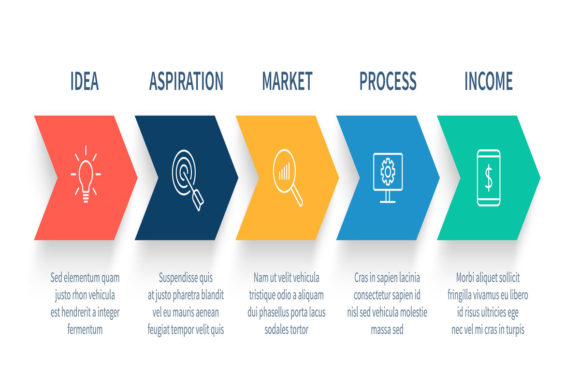
Arrow Process Steps Chart: Visualizing Workflow Success
Communicating complex business strategies or project timelines often fails when relying solely on text. Stakeholders, clients, and team members need immediate visual context to understand progression, dependencies, and goals. The Arrow Process Steps Chart serves as a foundational design element that transforms abstract concepts into clear, linear narratives. Whether you are mapping out a business startup phase, illustrating a manufacturing workflow, or presenting quarterly success stages, this type of diagram provides the structural clarity necessary for effective communication. It is not merely a decorative graphic; it is a functional tool that guides the viewer’s eye logically from inception to completion.
For professionals creating pitch decks, educational materials, or internal reports, having access to a high-quality vector template significantly reduces production time. Instead of drawing shapes from scratch or struggling with misaligned smart art in presentation software, designers can leverage pre-structured assets. This specific resource includes one vector EPS10 file and one JPEG 72ppi preview, offering both editability and immediate visualization. Understanding how to effectively utilize these arrow-based progression diagrams can elevate the professional quality of your deliverables while ensuring your message is understood instantly.
Clarifying Business Startup Phases and Growth Trajectories
Entrepreneurs and small business owners frequently face the challenge of explaining their roadmap to investors or new hires. A business startup step arrows diagram does more than list tasks; it visually implies momentum and forward motion. When you present a funding proposal, showing a polished progression project diagram demonstrates organizational maturity. It suggests that the chaotic early stages of a venture have been tamed into a manageable, sequential plan.
Consider a scenario where you are onboarding a new marketing manager. A text-heavy document outlining the first 90 days might be overlooked or misunderstood. However, an infographic concept utilizing distinct step arrows creates a mental anchor for each phase of integration. The viewer can quickly distinguish between the "research" stage, the "strategy" stage, and the "execution" stage based on color coding or spatial arrangement within the chart. This visual scaffolding supports better retention of information and aligns expectations across the team. Because the provided file is an EPS10 vector, you can easily modify the number of steps or relabel them to fit your specific industry vertical without losing resolution or aesthetic integrity.
Enhancing Workflow Graphs for Operational Efficiency
Operational teams benefit immensely from standardized visual language. A workflow graph using arrow motifs helps identify bottlenecks and handoff points that are often invisible in spreadsheet trackers. When process improvement specialists map out current states versus future states, the directional flow of arrows makes gaps in logic immediately apparent. If an arrow points to a dead end or loops back unnecessarily, the inefficiency becomes a visible problem rather than a hidden friction point.
This practical application extends beyond internal operations to client-facing documentation. Service providers, such as digital agencies or consultants, use these charts to manage client anxiety. By visualizing the service delivery process, clients understand exactly where they are in the pipeline and what comes next. This transparency builds trust and reduces repetitive status update meetings. Using a vector editor like Adobe Illustrator allows you to separate elements within the chart, enabling you to highlight only the relevant portion of the workflow for a specific discussion while keeping the master file intact for comprehensive overviews.
The Technical Advantage of Vector EPS10 Files
Digital assets come in many formats, but for professional process diagrams, vector superiority is undeniable. The inclusion of an EPS10 file ensures that your Arrow Process Steps Chart remains crisp at any scale. Unlike raster images that pixelate when enlarged for trade show banners or printed brochures, vectors rely on mathematical paths. This means you can resize the success stages diagram from a business card icon to a billboard without any degradation in quality.
Editability is the primary value driver here. While the JPEG 72ppi preview allows for quick insertion into emails or low-resolution drafts, the EPS10 file is the working asset. Users with access to vector editing software can:
- Separate Elements: Ungroup the chart to isolate individual arrows or text boxes for custom arrangements.
- Rebrand Colors: Change fill and stroke colors to match corporate identity guidelines precisely.
- Modify Geometry: Adjust the length, width, or curvature of arrows to accommodate longer labels or different aspect ratios.
- Add or Remove Steps: Duplicate existing arrow groups to expand a three-step process into a ten-step methodology without redesigning from zero.
This flexibility is crucial for freelancers and agencies managing multiple clients. A single master template can be adapted for healthcare, fintech, education, or retail simply by swapping text and adjusting the color palette. The time saved on geometric construction translates directly to billable hours spent on strategy and content refinement.
Strategic Applications Across Diverse Industries
The utility of a progression project diagram transcends specific job titles. Educators use these visuals to break down complex historical timelines or scientific cycles for students. Marketers employ them to illustrate customer journeys and conversion funnels. Project managers rely on them for Gantt-style visualizations that are more digestible than traditional scheduling software outputs. In each case, the arrow serves as a universal symbol of causality and sequence.
However, it is important to recognize where this format fits best. Linear arrow charts excel at depicting sequential processes where step B cannot happen until step A is complete. They are less effective for cyclical processes (which require circular diagrams) or matrix-based decision trees. When selecting this Arrow Process Steps Chart, evaluate whether your narrative is truly linear. If your workflow involves parallel processing or feedback loops, you may need to combine this asset with other diagrammatic elements or choose a network-style graph instead. Honest assessment of your data structure prevents forcing non-linear information into a linear container, which can confuse rather than clarify.
Best Practices for Customizing Infographic Concepts
Owning the asset is only the first step; applying design principles ensures the final output communicates effectively. When editing the EPS10 file in Adobe Illustrator or compatible software, maintain adequate whitespace between steps. Crowded arrows create visual noise that defeats the purpose of simplification. Use consistent typography hierarchy to differentiate between main stage titles and supporting details. The goal is scannability; a viewer should grasp the overall flow within three seconds.
Color psychology also plays a role in how success stages are perceived. Cool blues often convey stability and trust, making them suitable for financial or legal workflows. Warm oranges and reds imply energy and urgency, fitting for sales pipelines or launch sequences. Green universally signals completion or approval. Since the vector file allows full color manipulation, align your palette with the emotional tone of the presentation. Avoid using more than three to four distinct colors to prevent cognitive overload.
Finally, consider accessibility. Ensure sufficient contrast between arrow fills and text. When exporting for web use, provide alt-text descriptions of the process flow for screen readers. Even though the source is a visual vector, the information it contains must be available to all audiences. This attention to detail distinguishes professional communicators from amateur designers.
Making the Right Choice for Your Visual Needs
While this Arrow Process Steps Chart offers significant versatility, users should compare options based on complexity. For simple, high-level overviews, this linear format is ideal. For deeply technical engineering schematics involving hundreds of decision nodes, specialized flowchart software might be more appropriate initially, with this vector asset used for executive summary slides. The JPEG preview serves as an excellent checkpoint; if the static image conveys your core message effectively, the vector version will serve you well in production.
Ultimately, the value lies in bridging the gap between raw data and human understanding. By integrating professional-grade vector graphics into your workflow, you signal competence and respect for your audience's time. Whether documenting a startup journey or optimizing an enterprise workflow, clear visualization is a competitive advantage. This asset provides the structural foundation needed to build that advantage efficiently, allowing you to focus on the substance of your message rather than the mechanics of drawing shapes.