Evaluating Doodle Shapes for Professional Visual Communication
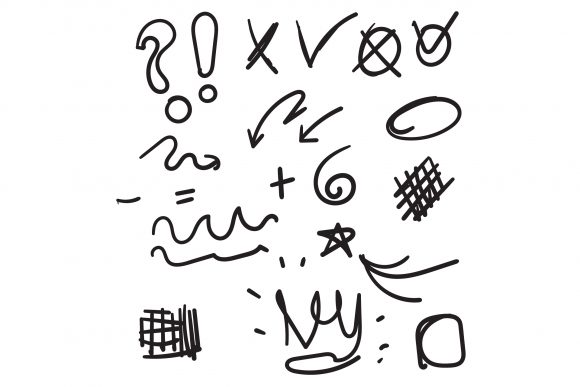
In the landscape of digital design and content creation, there is a persistent tension between polished professionalism and authentic human connection. While sleek, corporate aesthetics have their place, they often fail to engage audiences on an emotional level. This is where Doodle Shapes and hand-drawn simple shapes enter the professional workflow. Far from being mere childish scribbles, these assets represent a strategic design choice for marketers, educators, and entrepreneurs seeking to simplify complex information. When utilized correctly, abstract circles, arrows, and line art serve as functional visual anchors that guide attention, clarify hierarchy, and inject personality into otherwise sterile infographics and presentations.
The Functional Role of Hand-Drawn Line Art
To understand the value of doodle-based vector assets, one must look beyond their aesthetic charm and evaluate their utility in information architecture. In professional contexts, hand-drawn elements perform specific cognitive tasks that geometric perfection cannot replicate. The primary function of these shapes is visual pacing. In a dense infographic or a text-heavy slide deck, perfect grids and sharp vectors can create visual fatigue. Organic line art introduces necessary negative space and irregularity, allowing the viewer’s eye to rest and reset.
Furthermore, abstract circles and arrows act as non-verbal cues for navigation. A hand-drawn arrow pointing to a key statistic does not merely indicate direction; it implies a human recommendation. It suggests, "Look here, this matters," rather than the robotic command of a standard directional icon. For freelancers and small business owners creating their own marketing materials, this distinction is vital. It bridges the gap between automated content and personalized communication, fostering trust through perceived effort and authenticity.
Cognitive Accessibility and Engagement
Research in visual cognition suggests that imperfect, sketch-like visuals can lower the barrier to entry for complex topics. When presenting data to stakeholders or teaching a new concept to students, highly polished graphics can sometimes intimidate or imply that the subject matter is rigid and unchangeable. Doodle shapes signal approachability. They frame information as a work in progress or a conversation, which encourages audience participation and reduces cognitive load. For educators and trainers, integrating these elements into slide decks or worksheets can make abstract concepts feel more tangible and less academic.
Assessing Quality and Technical Flexibility
Not all doodle assets are created equal. For professionals aged 20 to 50 who are integrating these resources into client work or internal communications, technical quality is non-negotiable. The difference between a useful asset and a distracting mess lies in vector integrity and stylistic consistency.
- Vector Scalability: True Doodle Shapes must be provided in vector formats (SVG, EPS, AI). Rasterized doodles lose their crispness when scaled for large-format printing or high-resolution displays. Professional workflows demand infinite scalability without pixelation.
- Stroke Consistency: A common failure point in low-quality packs is varying stroke weights. If a circle has a 3pt line but the accompanying arrow uses a 1pt line, the composition feels disjointed. High-quality assets maintain uniform stroke width across the entire set, ensuring they look like they were drawn by the same hand in the same session.
- Editability: Practical usability requires that lines are actual paths, not expanded shapes. Professionals need the ability to adjust color, opacity, and even node curvature to match brand guidelines. Assets that are flattened or rasterized offer zero flexibility and should be avoided for serious projects.
- Visual Balance: Effective abstract shapes possess intentional imbalance. They should look organic but not sloppy. The best assets strike a balance where the imperfection feels curated rather than accidental.
Practical Applications Across Industries
The versatility of hand-drawn simple shapes makes them applicable across a wide spectrum of professional scenarios. However, their effectiveness depends entirely on context and execution. Below is an analysis of how different sectors leverage these assets effectively.
Marketing and Content Creation
For bloggers, social media managers, and digital marketers, Doodle Shapes are invaluable for stopping the scroll. In platforms dominated by AI-generated imagery and stock photography, a simple hand-drawn underline or asterisk stands out because of its rawness. They are particularly effective in carousel posts where they serve as transitional elements between slides, maintaining narrative flow without adding visual clutter. Marketers also use them to highlight calls-to-action (CTAs) subtly. A sketched box around a button feels less aggressive than a solid red rectangle, potentially increasing click-through rates by reducing ad blindness.
Corporate Training and Education
Educators and corporate trainers utilize these shapes to annotate and emphasize. Unlike static textbook diagrams, doodle overlays on presentation slides mimic the experience of whiteboard teaching. This is especially relevant for remote work and e-learning, where maintaining engagement is challenging. Abstract circles can group related ideas dynamically, while wavy lines can separate distinct sections without the rigidity of horizontal rules. For creators selling digital courses or templates, including a cohesive set of hand-drawn assets adds significant perceived value to the product.
Entrepreneurship and Pitch Decks
Startups and freelancers often struggle to appear established without looking generic. Hand-drawn elements in pitch decks can differentiate a brand identity. When used sparingly alongside clean typography and data visualization, doodles suggest creativity and innovative thinking. They soften the hard edges of financial projections and market analysis, making the presenter seem more relatable. However, this requires restraint; overuse can undermine credibility. The goal is accentuation, not decoration.
Strategic Implementation and Best Practices
Integrating Doodle Shapes into a professional workflow requires discipline. The most common mistake is treating them as filler rather than functional design elements. To maximize ROI on these assets, consider the following operational guidelines:
- Establish a Hierarchy: Decide early what role the doodles will play. Are they navigational aids? Emotional accents? Section dividers? Stick to one or two primary functions per project to avoid visual noise.
- Maintain Brand Alignment: Ensure the style of the line art matches your brand voice. A fintech company might require precise, thin-line geometric doodles, while a children’s book publisher would benefit from thicker, looser strokes. Mismatched styles create cognitive dissonance.
- Respect White Space: Hand-drawn shapes rely on breathing room. Crowding them against text or other graphics negates their organic appeal. Allow ample margin around each element to preserve its impact.
- Test for Accessibility: Always check contrast ratios. Light gray sketch lines may look elegant on a designer’s monitor but become invisible when projected in a conference room or viewed on a mobile device in sunlight. Functionality must precede aesthetics.
Limitations and Considerations
While valuable, Doodle Shapes are not a universal solution. There are contexts where they are inappropriate or counterproductive. Legal documents, medical instructions, and safety protocols generally require absolute precision; ambiguity in these areas can be dangerous or unprofessional. Additionally, audiences in highly conservative industries may perceive hand-drawn elements as unpolished or amateurish. Understanding your specific audience's expectations is paramount.
Another limitation is the risk of trend fatigue. As with any design trend, oversaturation can lead to diminishing returns. If every competitor in your niche uses the same popular doodle pack, the authenticity you seek to convey is lost. Professionals should either invest in unique, custom-created assets or significantly modify existing libraries to maintain distinctiveness. Reliance on free, low-effort assets often results in a generic appearance that fails to support long-term brand equity.
Evaluating Long-Term Value
For professionals considering the acquisition or creation of Doodle Shapes, the investment should be evaluated through the lens of longevity and adaptability. High-quality vector sets retain value because they are timeless in their simplicity. Unlike trendy 3D renders or complex gradients that date quickly, basic line art remains relevant across design cycles. The key is selecting assets that prioritize form and function over novelty.
Ultimately, the worth of these resources lies in their ability to solve communication problems. If a set of abstract circles and arrows helps you explain a process faster, engage a distracted audience, or humanize a corporate message, it has delivered tangible value. For the modern creator, entrepreneur, or educator, mastering the subtle art of hand-drawn visual aids is not about learning to draw; it is about learning to communicate with greater nuance and effectiveness. When selected with discernment and applied with intention, Doodle Shapes transform from simple decorations into powerful tools for professional clarity.